The comparison
Legong or kecak in Ubud?
Court dance with a gamelan at the palace, or the chanted kecak with fire: how the two Ubud evenings differ in music, story, length, venue and booking terms.
Book your legong ticket ↗Quick answer
Choose the legong at the palace for Bali's refined court dance, a live gamelan orchestra and a royal setting, over about ninety minutes. Choose the kecak for a circle of chanting men with no instruments at all, a Ramayana drama and a fire scene, in about an hour at one of several Ubud stages. The kecak ticket can be cancelled up to 24 hours ahead; the legong ticket cannot. Both are cheap, so many visitors see both on different nights.
The two tickets side by side
| Palace legong | Kecak and fire | |
|---|---|---|
| Music | Gamelan orchestra | Voices only |
| Story | Court tales in mime | The Ramayana |
| Length | About 90 minutes | About an hour |
| Venue | Palace courtyard | One of several stages |
| Cancellation | Non-refundable | Free up to 24 hours |
The short answer
With only one free evening and a wish to watch Balinese dance at its most precise, head to the palace for the legong. If you want sheer sound and spectacle, go to the kecak. The legong is about detail: the flick of a fan, a sideways glance, fingers bending back, all set against an orchestra of bronze. The kecak is about mass: dozens of voices chanting in interlocking rhythm while the Ramayana plays out in the middle of the circle. Neither is better. They answer different moods, and they cost so little that choosing between them is often a question of which night is free.
Two kinds of sound
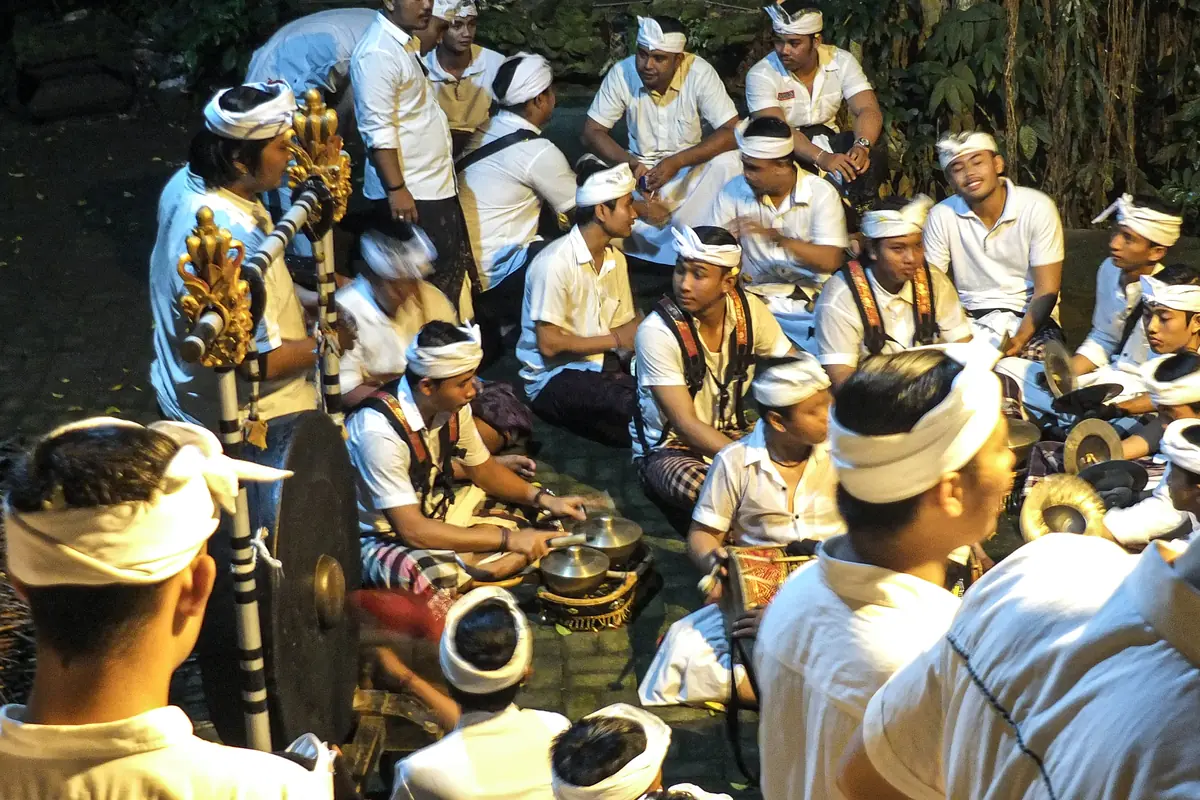
At the palace the music comes from a gamelan: metallophones struck with mallets, gongs, and a set of hand drums called kendang that keep the beat. Balinese instruments are built in pairs tuned slightly apart, so that together they shimmer with a pulse the Balinese call ombak, the wave. The kecak has no instruments. Its whole orchestra is human: most of the men repeat the cak syllable that names the dance, while a few take special jobs, one holding the pulse with po-po-po, one shouting the chorus to start and stop, one singing a melodic line, and a dalang narrating in Balinese and Sanskrit.
Two kinds of story
The legong kraton most often tells the tale of the king of Lasem, who wants to marry the princess Rangkesari, carries her off and rides to his death after a monstrous bird foretells it. The story is mimed by two dancers and an attendant, the condong. The kecak tells the Ramayana: the exile of Rama and Sita in the jungle of Dandaka, a golden deer, Ravana carrying Sita off, Jatayu's fight with Ravana, Hanuman searching for Sita, and Rama's battle with Ravana. The chanting men play both armies, Rama's monkey troops and Ravana's demons. If you know the Ramayana already, the kecak is easier to follow on a first visit.
Read next: The legong's Lasem story
A court dance and a 1930s creation
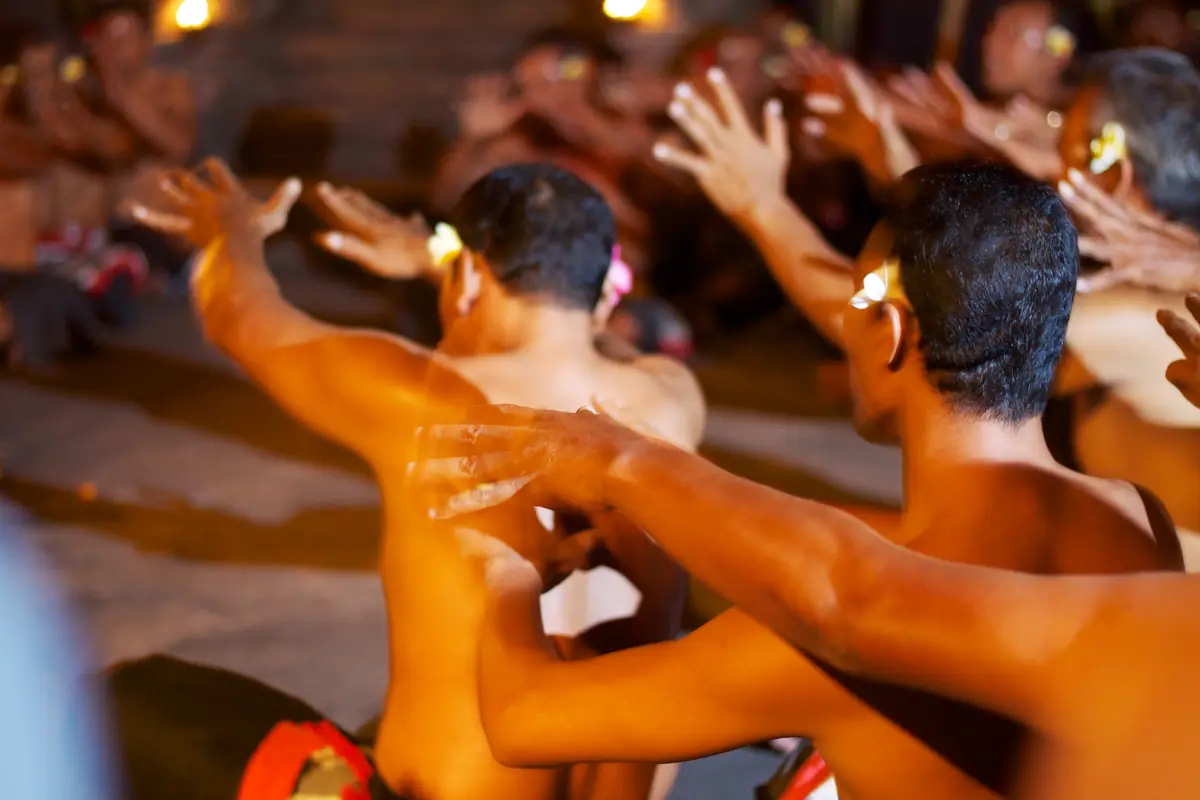
The legong probably began in the 19th century as entertainment for Bali's royal courts. The kecak is younger as a stage show. It grew from a trance ritual with a male chorus, rooted in sanghyang, and was popularised in the 1930s, when Walter Spies, a German painter and musician who lived in Ubud from 1927, worked with the dancer Wayan Limbak to shape it into a Ramayana drama for Western audiences. The scholar and choreographer I Wayan Dibia argues that Balinese performers were already developing the form when Spies arrived. Either way, both evenings you can book today are performances for visitors, not temple rites.
Where each one happens
The legong ticket takes you to one place: the courtyard of Ubud Palace, at the junction of Jalan Monkey Forest and the main street, where the stage is backed by a carved gateway with guardian statues. The kecak ticket works differently. Ubud has dance stages used for kecak in more than one place, and the ticket covers several venues; which one you attend depends on the option you choose, and your voucher names it. Read that voucher before you set out, so you walk to the right stage.
The fire, in proportion
The kecak is often sold as a fire dance, and there is real fire, but it is one scene rather than a whole show. The flames belong to the burning of Hanuman, and English Wikipedia describes trance rituals around that scene: a priest blesses the Hanuman dancer, who then kicks through the fire in a trance. Expect a short, striking scene near the end, not an hour of flames. The legong has no fire at all. Its drama is smaller in scale and lies in the faces and fans of three dancers.
Booking terms, side by side
The two tickets carry very different terms. The legong ticket is non-refundable and valid only on the date you choose, though tickets are also sold at the palace gate, so you can wait and buy on the night. The kecak ticket stays free to cancel until 24 hours before it starts, and payment can wait until later. Both are vouchers you show at the entrance, and both are cheap. In practice that means the kecak is the easier one to book early, and the legong is the one to book once your evening is certain.
- Legong: non-refundable, date-bound, gate tickets also sold
- Kecak: free cancellation up to 24 hours, reserve now and pay later
- Both: show the voucher, seats not reserved
Length, seats and comfort
The legong evening runs about ninety minutes on hard benches, with unreserved seating, so arrive at least 45 minutes early for the front rows and bring something to sit on. The kecak lasts about an hour; arrive at least 30 minutes ahead for the best seats, wear comfortable clothes and bring a light jacket or shawl, since the evening can turn cool outdoors. Flash photography is best avoided at the kecak so as not to disturb the performers. Both venues are wheelchair accessible. If anyone in your group struggles to sit still, the shorter kecak is the gentler choice.
Children and first-time visitors
Children pay the adult rate at the palace legong, and ninety minutes is a stretch for small ones; the gamelan is loud at the front, which some children love. The kecak is shorter and the chanting tends to hold attention, and the Ramayana's monkey hero gives younger viewers someone to follow. For any first-timer, reading the story before the evening transforms both shows: the Ramayana outline for the kecak, the Lasem tale for the legong. Ten minutes of reading beforehand is worth more than a seat in the front row.
Doing both
Because both tickets cost little and neither show lasts long, the strongest plan for a stay of three nights or more is simply to see both. Book the kecak whenever you like, since it can be cancelled until the day before, and add the legong once you know which evening you will spend in town. Watching the legong first has a small advantage: the orchestra and the court style make a useful contrast with the purely vocal kecak that follows. Check the date pickers for each ticket, because performances depend on the venue and the night, and plan dinner after rather than before.
Who each one isn't for
The palace legong is not for anyone who needs a refund if plans change, a cushioned seat or a quiet evening: the benches are hard and the gamelan is loud. Nor is it for visitors who want one dramatic spectacle; its pleasures are small and precise. The kecak is not for anyone who wants instruments or the refinement of court dance, and it may disappoint if you expect an hour of fire. If neither suits, Ubud's quieter evenings are a walk along the main street or dinner in a warung, and both shows will still be there tomorrow night.
Read next: Ubud Palace legong: worth it?
Frequently asked questions
Which is better in Ubud, legong or kecak?
Neither is better; they differ. The legong offers refined court dance with a gamelan orchestra for about ninety minutes. The kecak offers a chanting male chorus, a Ramayana drama and a fire scene in about an hour.
Does the kecak use any instruments?
No. The kecak uses only the human voice: a chorus chanting cak, a beat-keeper, a leader, a singer and a narrator.
Can I cancel either ticket?
Only the kecak one, without charge until 24 hours before the show. The palace legong ticket is non-refundable and tied to a single date.
Is the kecak at Ubud Palace?
Not on this ticket. The kecak ticket covers several Ubud stages, and your voucher names the one for the option you booked.
Is there fire in the legong?
No. Fire belongs to the kecak's Ramayana scene, in which Hanuman burns Ravana's city. The legong's drama is in the dancers' faces, fingers and fans.
Can I see both on one trip?
Yes, on different evenings. Both tickets are cheap and the shows are short, so a stay of three nights or more fits both easily.
Sources