The story
The legong's Lasem story
The king of Lasem, the princess Rangkesari, the condong and the bird of ill omen: the tale behind the legong kraton, scene by scene, with sources.
Book your legong ticket ↗Quick answer
The legong kraton most often mimes the tale of the king of Lasem, an East Javanese ruler who wants to marry the princess Rangkesari. She refuses him, he captures her, her family goes to war, and as he rides out a monstrous bird foretells his death. Two legong dancers carry the story with their fans, and a third dancer, the condong, opens the dance and later becomes the bird.
The three dancers
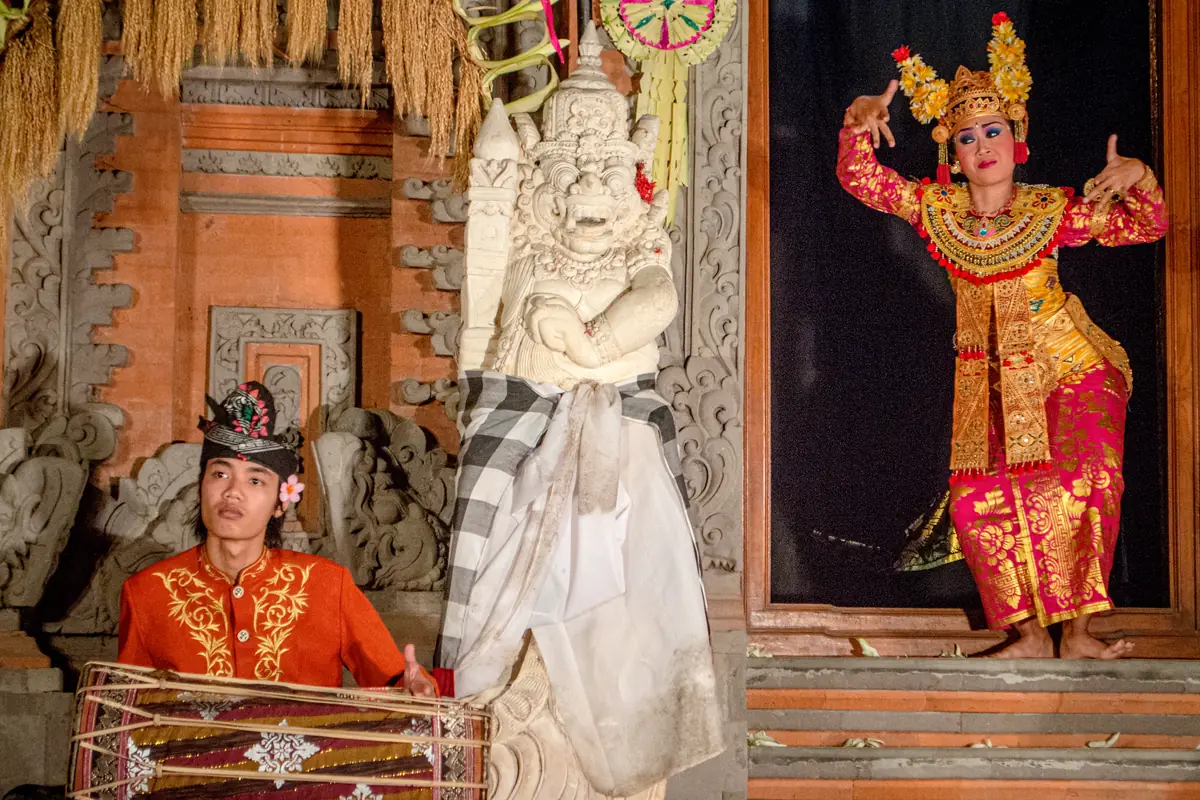
The classical legong kraton uses three dancers. The condong is an attendant: she appears first, sets the scene and presents the other two with their fans. The two legong then take up the story together. The Indonesian article on the legong notes that the condong carries no fan of her own, and that a repertoire with all three dancers is what is known as the legong kraton. Balinese dance lists condong as a basic dance in its own right, a preface to legong.
A king who wants a bride
The tale's villain is the king of Lasem, whom English Wikipedia calls an East Javanese ruler. He is at war with another king and wants to marry the princess Rangkesari. The Indonesian article gives the setting more fully: the princess belongs to the kingdom of Daha, also called Kadiri, and she refuses the king because she is already bound to Prince Panji of Kahuripan, hero of a whole cycle of Javanese romances.
Flight and capture
In the English telling, Rangkesari detests Lasem and tries to run away, loses her way in the forest and is captured by him there. He shuts her away and prepares a final assault on her family. In the Indonesian telling the episode is shorter and harsher: he simply abducts her. On stage, all of it is carried by gesture, gaze and the movement of the fans.
The bird of ill omen
The turning point comes as Lasem leaves for battle. He is attacked by a monstrous bird that foretells his death. English Wikipedia calls it a raven; the Indonesian article calls it a garuda bringing death. Either way, it is the condong who returns to dance the bird, which is one reason to keep an eye on her even after the two legong have taken centre stage.
How the story ends
The English article stops with the omen. The Indonesian one completes the story: Rangkesari's brother, the king of Daha, declares war, Lasem escapes the bird, and he then dies in battle against the king of Daha. For visitors, companies stage excerpts of legong dramas rather than the whole tale, so on any given night you may see only part of this arc, told in elaborate, stylised pantomime.
Where the tale comes from
English Wikipedia places the story in the Malat, a collection of heroic romances. The Indonesian article ties it to a branch of the Panji stories, which it dates to the 12th and 13th centuries and the Kadiri kingdom, and notes that Lasem now lies within Rembang regency. Both point the same way: to East Java, and to the court romances that Balinese palaces inherited and turned into dance.
Other legong stories
The Lasem tale is the most performed legong story, yet others exist. The Indonesian article lists other legong: the legong jobog, drawn from the Ramayana's quarrel between the brothers Sugriwa and Subali, a legong about the gods Brahma and Wisnu, and the legong kuntul, in which a group of herons is shown at play. English Wikipedia notes that some fifteen kinds were traditionally known, each with its own length, movement and story. Which dance you see at the palace is the company's choice, so treat this page as a key to the most likely one rather than a programme.
Read next: Ubud Palace legong: worth it?
Frequently asked questions
What story does the legong tell?
Most often the tale of the king of Lasem, who wants to marry the princess Rangkesari, captures her and dies after a bird foretells his death.
Who is the condong?
An attendant who dances first, sets the scene, gives the two legong their fans and later plays the bird of ill omen.
Is the bird a raven or a garuda?
English Wikipedia calls it a monstrous raven; the Indonesian article calls it a garuda bringing death.
Will I see the whole story at the palace?
Not necessarily. Visitors are usually shown excerpts of legong dramas, and the company decides each night's dances.
Sources