The music
The gamelan behind the legong
What the orchestra at the palace is made of, why paired bronze instruments shimmer, how interlocking parts work, and how kebyar changed the legong's fortunes.
Book your legong ticket ↗Quick answer
The music at the palace comes from a gamelan, Bali's ensemble of bronze metallophones, gongs and drums. The legong has its own ensemble tradition, the pelegongan, closely related to the old court gamelan semar pegulingan. Paired instruments tuned slightly apart create a pulsing shimmer, interlocking parts split fast melodies between players, and hand drums keep the beat. Knowing what to listen for makes the dancing easier to read.
What a gamelan is
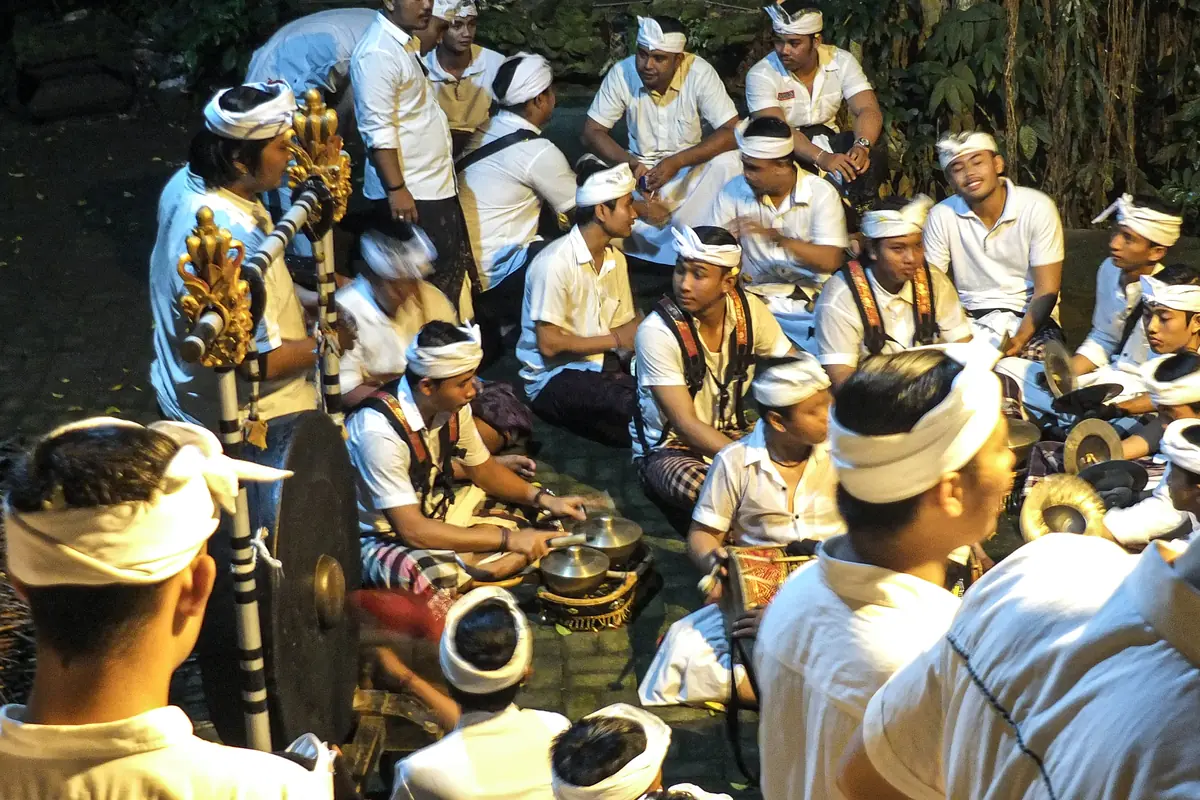
Gamelan is the traditional ensemble music of the Javanese, Sundanese and Balinese peoples, made up mostly of percussion. The commonest instruments are metallophones played with mallets and a set of hand drums called kendang, which keep the beat. Balinese dance is tied tightly to it: movement follows the rhythms of the gamelan, with face, eyes, hands, hips and feet each picking out a different layer of the sound.
The legong's own orchestra
The old court gamelan semar pegulingan dates from around the 17th century and is sweeter and more reserved than the better-known kebyar style. Semar is a god of love, and the ensemble was once played near the palace sleeping chambers. A close relative, the gamelan pelegongan, swaps the melody instrument for a pair of genders and plays the music for the dances known as legong. The Indonesian article on the legong simply names semar pagulingan as its accompaniment. In a courtyard, listen for that sweeter tone beneath the drumming.
Why the bronze shimmers
Balinese gamelan instruments are built in pairs tuned slightly apart. Played together, they produce interference beats, which the Balinese hear as ombak, a wave. One instrument of each pair, a little higher, is thought of as the inhale and the other as the exhale. This is why a Balinese orchestra seems to pulse even on a held note, and why the sound in the front rows feels physical rather than merely loud.
Interlocking parts
Balinese gamelan is famous for kotekan, interlocking patterns in which a fast melody is split between two players. One part, polos, falls mostly on the beat; the other, sangsih, mostly off it. Heard together, they sound like a single impossible line. Each pair of these metallophones, called gangsa, is divided into the two parts, which allows extremely rapid and complex patterns. The player strikes a key with a mallet in one hand and damps it with the other, so that each note stops cleanly as the next one sounds. Watch the mallets and you can see the melody passing back and forth between paired instruments.
How kebyar changed the legong
Gong kebyar, whose name means to flare up or burst open, was first documented in north Bali in the early 1900s, with its first public performance in December 1915 at a competition in Jagaraga. Its sudden changes of tempo and volume swept the island. The Indonesian article on the legong says the older court dance lost popularity in the early 20th century to kebyar, and that work to revive it began in the late 1960s.
Gamelan beyond the palace
The orchestra you hear at the palace is not only a stage instrument. Gamelan gong kebyar has become an essential part of modern Balinese Hindu ceremonies: it is required for odalan, the annual birthday ceremonies of temples, and for major holidays, where it accompanies sacred dances, and it plays at weddings too. Around Ubud, a gamelan heard drifting out of a temple courtyard in the afternoon is usually a village ensemble at work, not a performance for visitors. The palace evening gives you a seat and a stage; the music itself belongs to Balinese life well beyond it.
How to listen in the courtyard
Sit where you can see both the dancers and the musicians, because in Balinese dance the movement is closely tied to the rhythms of the gamelan. Notice when the music thins to a few instruments and the dancer's eyes take over, then swells as the fans snap shut. The gamelan is loud near the stage. If you want the shimmer of the pairs rather than the full force of the gongs, a seat a few rows back is the better place to hear it.
Read next: Legong or kecak in Ubud?
Frequently asked questions
What kind of gamelan plays for the legong?
The pelegongan, a close relative of the old court gamelan semar pegulingan, is the ensemble associated with legong.
Why does the gamelan seem to pulse?
Instruments are built in pairs tuned slightly apart, creating interference beats the Balinese call ombak, the wave.
Is the gamelan loud?
Yes, especially near the stage. Sit a few rows back if you prefer a gentler sound.
Sources